
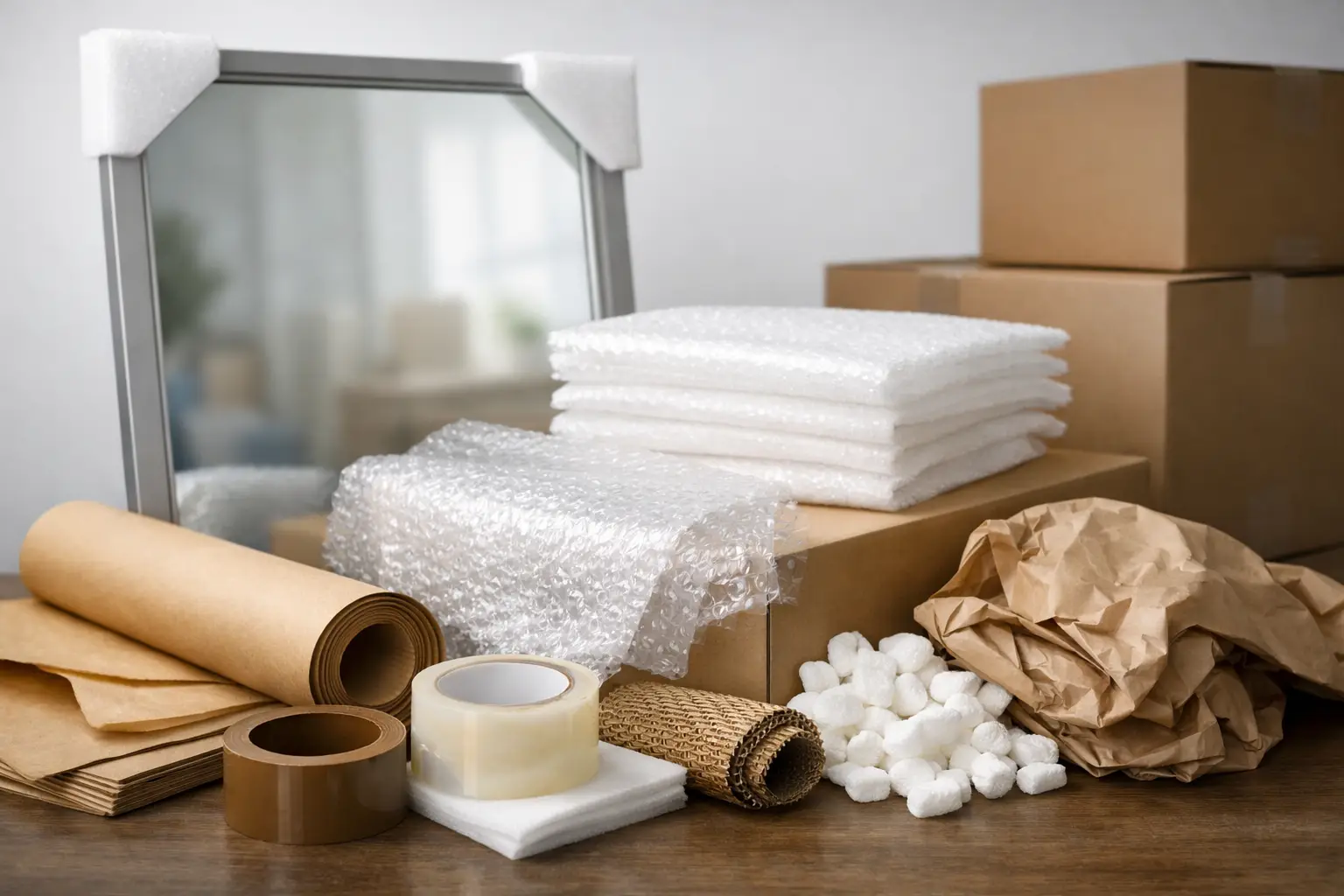
A mirror can look well protected until one sharp knock, a poorly supported corner or a heavy box placed against it proves otherwise. The best packing materials for mirrors do more than cushion the glass: they protect vulnerable edges, prevent flexing and keep the mirror stable from the moment it leaves the wall until it reaches its new room.
For a small bathroom mirror, careful wrapping and a suitable box may be enough. For a large wall mirror, framed antique or full-length design, stronger protection and experienced handling are usually the safer choice. The key is to match the materials and method to the size, weight and value of the item.
Why mirrors need more than a layer of bubble wrap
Glass does not always break where the impact happens. A mirror can crack because its frame twists during lifting, because its corners strike the floor, or because it is allowed to move inside a box. Larger mirrors are particularly prone to damage when carried flat, as the glass can flex under its own weight.
Good packing therefore works in layers. The surface needs protection from scratches, the corners need impact resistance, the frame needs support, and the finished package must fit securely into an appropriate carton. It also needs to be loaded upright in the removal vehicle, where it cannot slide or be pressed by heavier belongings.
Best packing materials for mirrors
Glass protection tape
Low-tack masking tape or specialist glass protection tape is useful for reducing the spread of shards if the glass breaks. Apply it in a large X across the mirror, then add a horizontal and vertical strip if required. Do not use tape that may leave residue or damage delicate finishes, and never rely on tape as the main form of protection.
For antique mirrors, gilded frames or pieces with an aged backing, it is sensible to avoid placing tape directly on any sensitive surface. A professional packing team can assess this before packing.
Corner protectors
Foam or cardboard corner protectors are among the most valuable materials for framed mirrors. Corners are the first points to meet a doorway, skirting board or another item in transit, and even a small impact can damage both frame and glass.
Use purpose-made protectors where possible, choosing a size that fits firmly without crushing the frame. For especially large mirrors, reinforced cardboard corners may be combined with foam padding for greater protection.
Bubble wrap and foam sheeting
Bubble wrap provides useful shock absorption, particularly around the frame and corners. Wrap the mirror in at least two layers, with the bubbles facing outwards where practical so the smooth side rests against the surface. Secure the wrap with packing tape, but keep tape on the wrapping rather than the mirror itself.
Foam sheeting is a good first layer for polished frames, painted finishes and glass surfaces that could be marked by other materials. It is thinner than bubble wrap, so it works best underneath it rather than as a replacement. For a valuable or unusually shaped mirror, this combination gives better protection than bubble wrap alone.
Cardboard sheets and mirror cartons
Stiff cardboard sheets prevent the glass from flexing and help spread the force of a knock. Place a sheet on both the front and back of the wrapped mirror, extending slightly beyond the frame where possible. This creates a more rigid parcel and gives the corners additional support.
Purpose-made mirror cartons are the preferred option for standard-sized mirrors. They are often supplied as adjustable sections that slide together around the item. The carton should be close-fitting but not so tight that it puts pressure on the frame. Fill any small gaps with scrunched packing paper or additional foam, not loose household textiles that can shift during transport.
Packing paper and corrugated card
Clean packing paper is useful for filling voids inside a carton and separating protective layers. It is not sufficient as the main wrapping for a mirror, but it helps stop movement once the item is boxed.
Corrugated cardboard is particularly helpful for oversized or irregularly shaped mirrors that do not fit a standard carton. Two strong sheets, cut larger than the mirror and taped securely around the edges, can create a protective sandwich. This method should still include foam, bubble wrap and corner protection underneath.
Furniture blankets and straps
For large mirrors that are being transported directly in a removal vehicle rather than boxed, padded furniture blankets provide an additional protective layer. They should be wrapped around the already protected mirror, then held in place with removal straps. Straps must be secure without being overtightened, as excessive pressure can damage the frame or glass.
This approach is often used for large pieces that cannot be safely manoeuvred into a carton. It requires careful loading, proper vehicle securing points and enough space for the mirror to remain upright throughout the journey.
How to pack a mirror safely
Start by checking the frame, hanging fittings and existing condition. Take a quick photograph before packing, especially if the mirror is valuable or has any existing marks. Remove loose fittings where possible, or protect them with a small pad of bubble wrap.
Clean, dry hands are preferable when handling glass. First apply glass protection tape if suitable for the mirror, then place foam sheeting over the face and back. Add corner protectors before wrapping the whole piece in bubble wrap. Finally, sandwich it between cardboard sheets or place it in a mirror carton.
Seal the package firmly with strong packing tape and clearly mark it as fragile. Labelling is useful, but it does not replace correct handling. Anyone lifting the mirror should know which way is upright and where the weight is concentrated.
Common packing mistakes to avoid
The most frequent mistake is using a blanket or duvet as the only protection. Soft furnishings may prevent surface scratches, but they do not stop a mirror from bending or protect the corners from a hard impact.
Another problem is packing a mirror flat at the bottom of a box or laying it flat in a vehicle. Mirrors should normally travel upright on their longest edge, with support on both sides. This reduces flexing and makes it easier to secure the piece safely.
Avoid leaving empty space inside the box, using damaged cartons, or placing a mirror with heavy items. Books, tools and boxes of kitchenware can shift during braking and put dangerous pressure on the glass. It is also unwise to carry a large mirror alone: the item can be awkward, heavy and difficult to control around tight corners or stairs.
When professional packing is the better option
Professional packing is worth considering for oversized mirrors, expensive framed pieces, antiques, bevelled glass and mirrors that need to go into storage. These items may require custom cardboard protection, specialist covers and a planned route from room to vehicle.
At Phoenix Rising Removals and Storage, trained crews can pack fragile household items using suitable materials, load them into purpose-built vehicles and secure them for the journey. This can remove a significant source of worry when moving home, particularly when there are stairs, narrow access points or several fragile items to manage on the same day.
If a mirror is going into storage, keep it upright in a dry, stable position with nothing leaning heavily against it. The packing should remain in place for the full storage period, as repeated unwrapping and rewrapping creates extra handling risk.
A well-packed mirror is not just about avoiding broken glass. It means arriving at your new home with one less job to repair, replace or worry about, leaving you free to focus on getting settled.