
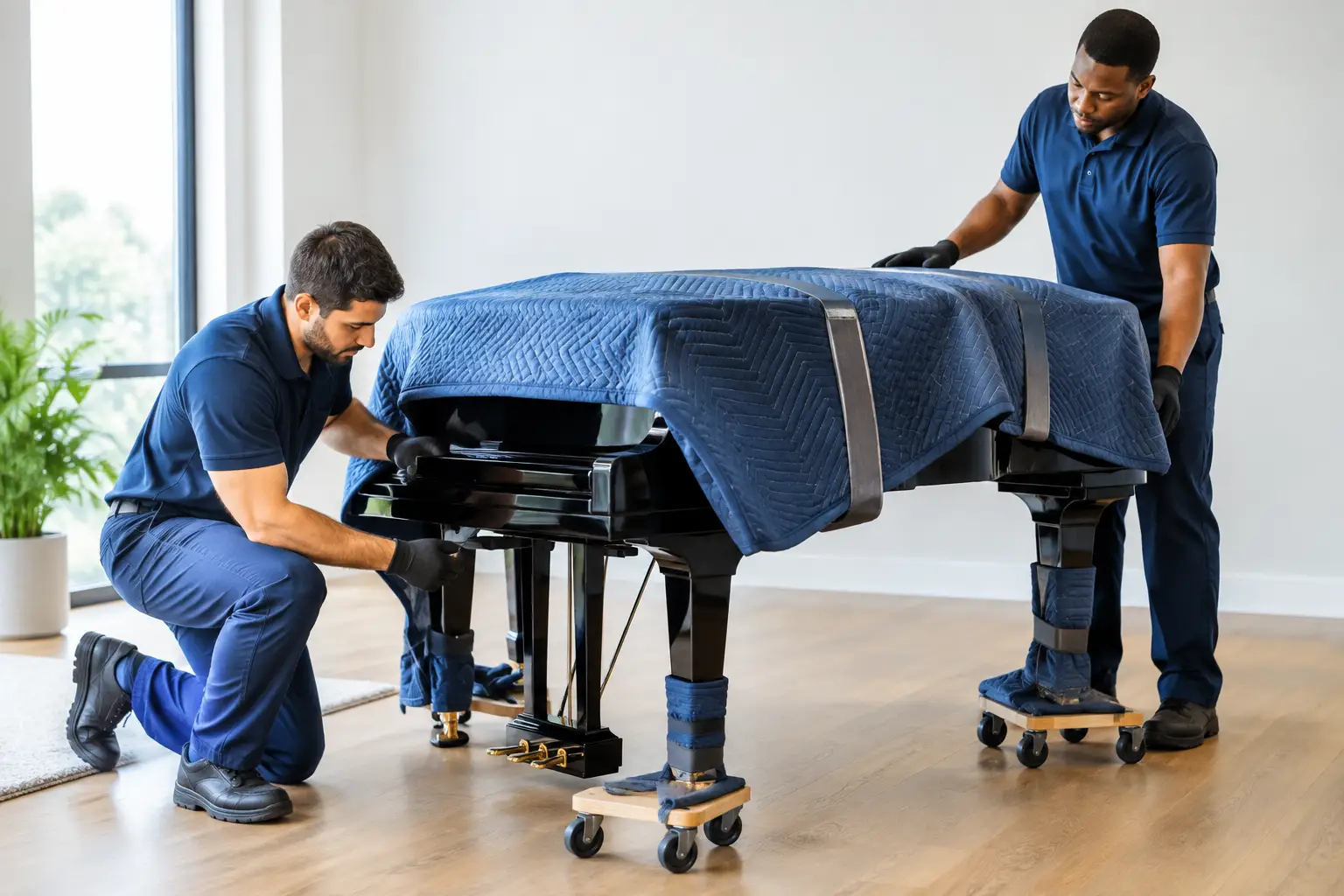
A piano is one of the few household items that can look manageable until it is time to move it. Whether you need to prepare the piano for removal from a ground-floor room or a top-floor flat, its weight, uneven balance and delicate internal mechanism make careful planning essential. A safe move begins well before the removals team arrives.
Pianos are not simply heavy pieces of furniture. The cast-iron frame, strings, soundboard, pedals and polished exterior all need protecting, while the instrument must be kept stable through doorways, over thresholds and into the vehicle. Trying to move one with unsuitable equipment or too few people can cause injury, damage to the piano and damage to your property.
How to prepare a piano for removal
The right preparation depends on the type of piano, the access at both properties and whether the instrument is going directly to its new home or into storage. An upright piano is usually more straightforward than a grand piano, but both require specialist handling and a clear route.
Start by identifying the piano type and, if possible, its approximate dimensions. Uprights vary considerably in height and depth, while grand and baby grand pianos have a wider footprint and may require dismantling before transport. If you have the make, model and serial number, keep these details available for the removals survey. They can help the team assess the likely weight and handling requirements.
Do not attempt to remove legs, pedals, internal panels or other components unless you have been specifically advised to do so by a piano specialist. These parts are not designed for casual dismantling. Incorrectly removing them can affect the piano’s structure, action or finish, and can make it harder to move safely.
Measure the route, not just the piano
The most common difficulty is not the piano itself but the route it must travel. Measure the narrowest points from its current position to the vehicle, including internal doors, hallways, landings, stairwells, gates and paths. Remember to allow for turning space, not just the width of a doorway.
Check for low ceilings, tight corners, raised thresholds, loose paving and steps. At the new property, repeat the same process from the parking position to the room where the piano will sit. A route that looks clear at first glance may still be unsuitable if there is no room to rotate the instrument safely.
Tell your removals company about any access concerns early. Narrow staircases, multiple flights of stairs, restricted parking, lifts, shared entrances and steep driveways can all affect the plan. In some cases, an external lift or other specialist arrangement may be needed. It is far better to establish this before moving day than to discover an obstacle with the piano halfway through the house.
Clear and protect the route
Create a clear passage from the piano to the exit. Move rugs, side tables, shoes, toys, picture frames and anything else that could become a trip hazard. Open internal doors fully where possible and secure them so they cannot swing closed during the move.
Protect vulnerable areas of the property, particularly painted walls, banisters, corners and door frames. Professional movers will normally bring padded covers, floor protection and securing equipment, but making the route clear helps them work efficiently from the moment they arrive.
If the piano is close to a wall, move ornaments, lamps and framed photographs from nearby surfaces. The removals team needs space to position protective coverings and safely take the instrument’s weight. Keep children and pets away from the working area until loading is complete.
Preparing the piano itself
Close and lock the keyboard lid if your piano has a lock. If there is no lock, make sure the lid is shut and advise the removals team. Never use tape directly on polished wood, veneer or lacquered surfaces, as adhesive can mark the finish or pull away delicate material.
Remove loose items from the piano and the area around it. This includes music books, metronomes, candles, vases and decorative objects. Take photographs of the piano from several angles before collection, especially if it has existing scratches or marks. This is a sensible record for any valuable or sentimental item.
Avoid polishing the piano immediately before the move. Fresh polish can make surfaces slippery, which is unhelpful when the instrument is being handled. A light dust with a soft, dry cloth is enough. If the piano has been exposed to damp, cold or direct sunlight, mention this to the team so they can take appropriate care during loading and transport.
The piano should be wrapped in thick, clean padded covers, with extra protection for corners and the keyboard area. It must then be secured upright within a purpose-built removals vehicle so it cannot shift in transit. A piano should never be laid on its side unless a trained team has determined that this is necessary for a particular handling stage and can protect it correctly.
Be realistic about weight and balance
Even a small upright piano often weighs well over 150kg, and some models weigh substantially more. The weight is concentrated in the cast-iron frame, meaning the piano can become dangerously unbalanced if lifted or tilted incorrectly. Furniture straps, a piano trolley and enough trained handlers are not optional extras – they are central to a safe removal.
For this reason, avoid asking friends or family members to help with a piano unless they have relevant moving experience and the correct equipment. The potential saving is rarely worth the risk of a serious injury, a damaged staircase or a damaged instrument. Professional removals teams assess the load, use safe lifting techniques and plan how the piano will be controlled at every point of the route.
Plan for parking, weather and timing
Reserve suitable parking as close to the property as possible. If you live on a narrow road, in a permit-controlled area or near a busy high street, check whether a parking suspension or permit is required. The shorter and clearer the distance from door to vehicle, the less handling is needed.
Wet weather does not always prevent a piano move, but it does require sensible precautions. Rain can affect polished finishes and make paths slippery, while extreme cold or heat can place the instrument under stress. A professional team will protect it from the elements during loading and minimise the time it spends outside.
Allow adequate time in the moving schedule. A piano should not be treated as the final item to squeeze in after a long day of loading. If access is difficult, it may need to be moved at a particular point in the day when the property is less congested and the team can focus fully on the task.
If the piano is going into storage
A piano going into storage needs more than a dry corner. Changes in temperature and humidity can affect timber, felt, glue and the tuning stability of the strings. Choose secure storage that is clean, dry and suitable for household possessions, and make sure the piano is protected from dust, knocks and prolonged damp.
Before storage, remove music and personal items, photograph the instrument and make sure its condition is recorded. Ask whether the removals provider can collect, wrap, transport and store the piano as part of the same service. Keeping responsibility with one experienced team can reduce handovers and unnecessary handling.
When it comes out of storage or arrives at its new home, give the piano time to settle to the room temperature before arranging a tuning. A move can alter tuning slightly even when the instrument is carefully transported. Most piano technicians recommend waiting a few weeks after delivery, particularly if the piano has experienced a noticeable change in temperature or humidity.
What to tell your removals company
A detailed description allows the move to be planned properly. Provide the piano type, approximate dimensions, its current room, the floor level, any stairs or tight turns, and clear photographs of difficult access points. Also mention parking restrictions, whether there are steps outside, and where the piano will be placed at the destination.
Phoenix Rising Removals and Storage can assess the wider move as well as the piano itself, helping to coordinate packing, loading, transport and storage where needed. Insured, experienced handling and suitable vehicle space provide reassurance when an item cannot simply be boxed and carried.
A piano often holds years of family memories as well as real financial value. Give its removal the same attention you would give to choosing its new place in the home: a clear route, the right equipment and skilled hands make all the difference.