
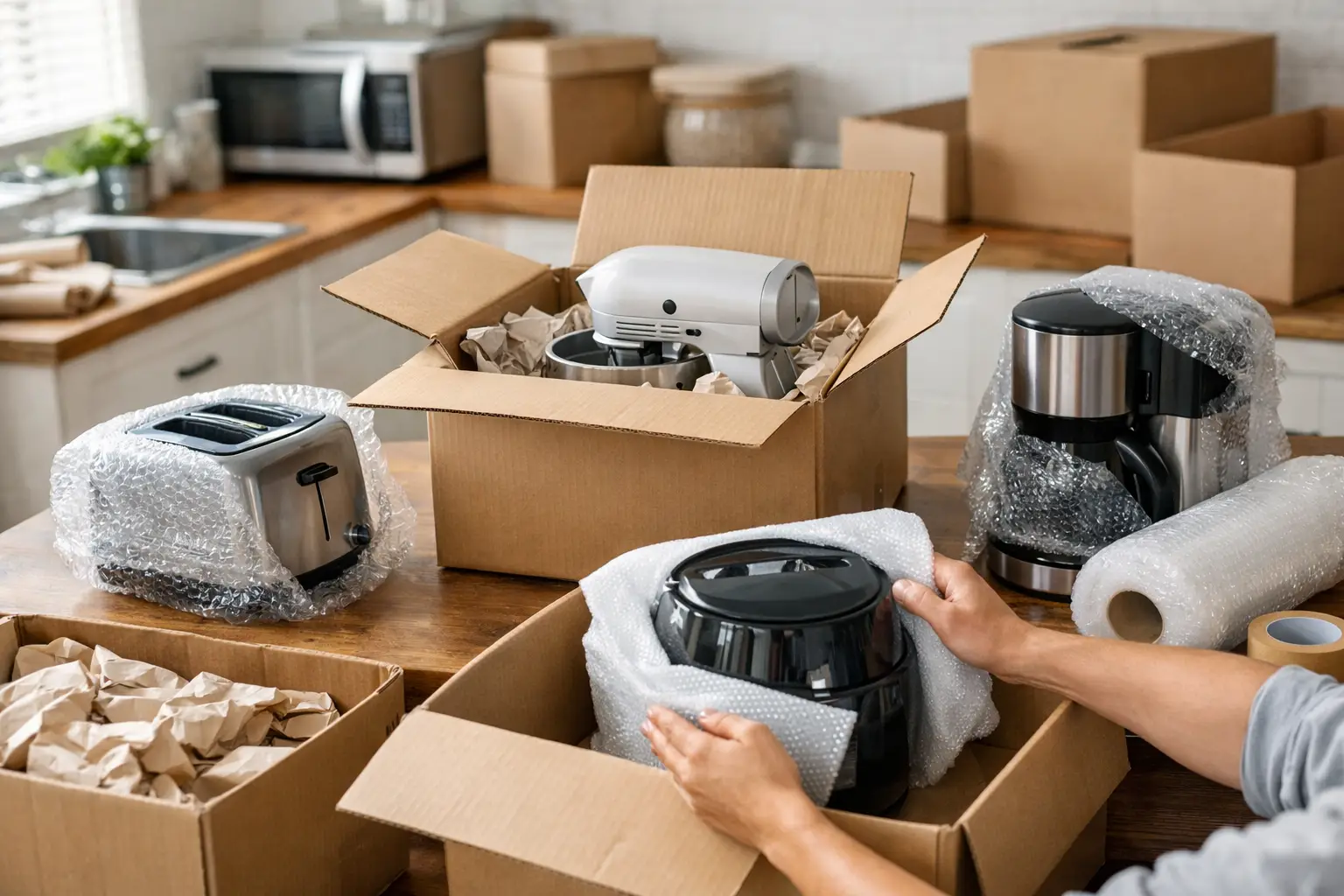
The kitchen is often the last room people pack and one of the easiest places for moving-day damage to begin. To pack kitchen appliances safely, start earlier than you think: appliances need cleaning, drying, securing and, in some cases, professional disconnection. A little preparation protects expensive equipment, prevents leaks in the removal lorry and makes settling into your new home far less stressful.
Prepare appliances before you pack
Do not pack appliances straight from the worktop or cupboard. Crumbs, moisture and loose components can cause damage during transport, particularly when boxes are stacked or carried at an angle.
Empty every appliance completely. Remove food, water, coffee grounds, ice, filters and detachable parts. Wipe down the exterior and clean the inside according to the manufacturer’s instructions. Allow everything to dry fully before wrapping it. A sealed box containing even a small amount of moisture can leave you with mould, odours or corrosion by the time you unpack.
Keep manuals, warranties, spare filters and small accessories together where possible. If you no longer have the original instructions, take a few photographs before dismantling anything with several settings or attachments. This is particularly useful for food processors, stand mixers and coffee machines.
Cables need attention too. Coil each lead loosely, secure it with a cable tie or packing tape, and tape it to the appliance rather than letting it move freely. Avoid winding a cable tightly around an appliance, as this can strain the wire or plug.
How to pack small kitchen appliances safely
Small appliances may not look fragile, but their motors, glass components and electrical fittings can be damaged by knocks. Original boxes with fitted inserts are the best option. If you have kept them, use them.
If not, choose a strong double-walled box that is only slightly larger than the appliance. Line the base with crumpled packing paper or bubble wrap, then wrap the appliance individually. Pay particular attention to corners, handles, screens and glass panels. Fill all empty space so it cannot shift when the box is lifted.
For heavier items such as stand mixers, bread makers and air fryers, use smaller boxes rather than one large carton. A box that is too heavy is more likely to be dropped and harder for the removal team to handle safely. Mark it clearly as heavy and note which way up it should travel.
Kettles, coffee machines and blenders
Kettles and coffee machines must be fully drained and dry. Remove reusable filters, water reservoirs and drip trays if these parts can be packed separately. For coffee machines, follow the manufacturer’s guidance for cleaning or descaling before a move.
Wrap glass blender jugs separately from their bases. Do not leave blades loose in a box. Remove them if the design allows, wrap them carefully and place them in a labelled bag or small box. Keep the bag with the blender, but do not pack sharp parts where they could press against glass.
Microwaves, toasters and air fryers
Remove the microwave turntable and wrap it separately. Secure the door with a small amount of tape over protective paper or card, never directly against a surface that could be marked. For toasters and air fryers, empty crumbs and grease residues first, then protect control panels and handles with additional wrapping.
Microwaves can be surprisingly heavy. Keep the box compact and ensure it is labelled as fragile, even though the outer casing appears sturdy.
Take extra care with large appliances
Large kitchen appliances need more than good wrapping. Their condition, connections and weight must be considered before removal day. If there is any uncertainty about disconnecting an appliance, arrange for a qualified professional to do it.
Fridges and freezers should be emptied well in advance. Defrost them at least 24 hours before the move, although larger appliances may need longer. Place towels around the base to catch melting ice, clean the interior and leave the doors open long enough for all moisture to evaporate.
Remove shelves and drawers where practical, wrapping them separately. Secure the doors so they cannot swing open, but avoid using tape directly on delicate finishes. Most fridges and freezers should be kept upright in transit. After delivery, allow the appliance to stand upright before switching it on. The recommended waiting time varies by manufacturer, so check the manual.
For washing machines and dishwashers, turn off water supplies and disconnect hoses carefully. Drain any remaining water from the appliance and hoses, then dry them before packing. Washing machines normally require transit bolts to secure the drum. If you no longer have them, contact the manufacturer or a suitable supplier before moving it. Transporting a washing machine without the correct bolts can cause costly internal damage.
Cookers, hobs and gas appliances require particular caution. Do not attempt to disconnect or reconnect a gas appliance unless you are qualified to do so. A Gas Safe registered engineer can make the appliance safe for removal and ensure it is correctly installed at the new property. Electric cookers may also need professional attention depending on the connection.
Use the right packing materials
New, clean boxes provide better protection than worn cartons that have been stored in a damp garage or loft. Use packing paper for most wrapping and reserve bubble wrap for vulnerable edges, glass and electronic controls. Avoid packing appliances in bin bags. They tear easily, trap moisture and offer very little protection.
You will usually need a combination of:
- Strong, correctly sized boxes
- Packing paper and bubble wrap
- Packing tape and cable ties
- Cardboard corner protectors or stiff card
- Labels and a marker pen
Do not overfill boxes. The lid should close without forcing it down, and there should be enough internal padding to stop movement. Once taped, gently tilt the box from side to side. If you can feel or hear the appliance moving, add more packing material.
Label boxes for safe loading and easy unpacking
Clear labels make a practical difference. Write the room, contents and handling instruction on at least two sides of each box. “Kitchen – coffee machine – fragile – this way up” is much more useful than simply writing “kitchen”.
Keep a separate essentials box for the first evening and morning in your new home. Include a kettle, mugs, tea or coffee, basic utensils and any small appliance you will need immediately. Pack it securely, but keep it with you if possible rather than loading it deep inside the vehicle.
When loading, heavy appliances should sit low and upright, secured against movement. Small appliance boxes should not be placed beneath furniture, large pans or other heavy items. A careful loading plan matters as much as the wrapping itself.
When professional packing is the safer choice
Packing a few worktop items is manageable for many households. However, a full kitchen can take far longer than expected, especially when you are balancing cleaning, key collection, children, work commitments and the rest of the home.
Professional packers bring suitable materials, understand how to protect awkward items and load them with the wider move in mind. This can be particularly valuable for high-value coffee machines, American-style fridge freezers, range cookers or a busy family kitchen with many fragile accessories.
Phoenix Rising Removals and Storage can provide packing support alongside removals, storage and moving supplies, helping households across southern England prepare for local or nationwide moves with less pressure on moving week.
A well-packed appliance should arrive clean, dry, secure and ready to reconnect when the time is right. Give your kitchen the preparation it deserves, and the first hot drink in your new home will feel like a much better start.