
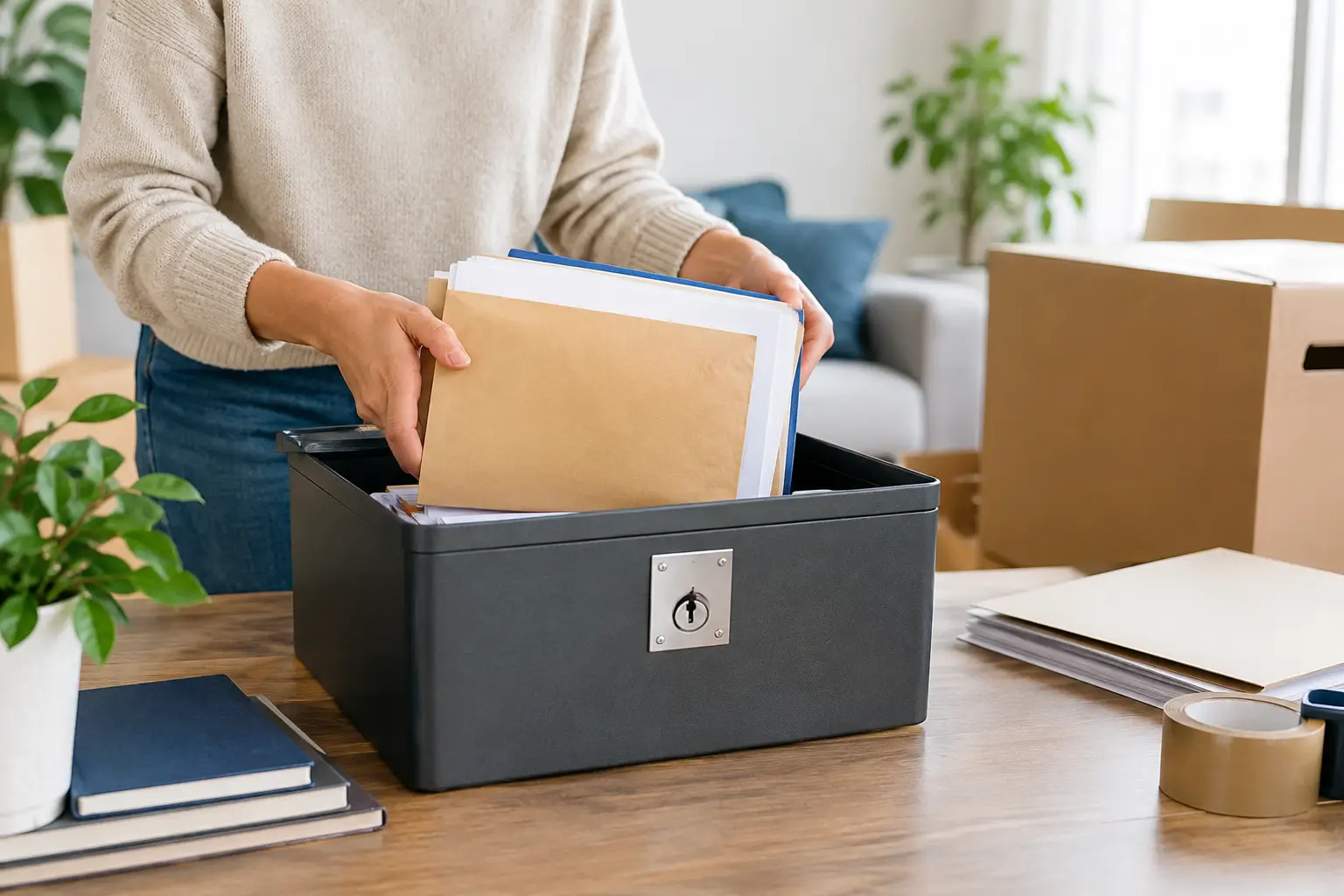
Moving day can make paperwork disappear surprisingly quickly. A passport placed in a ‘safe’ box, a tenancy agreement mixed in with books, or insurance papers left in a drawer can create avoidable stress when you need them most. This secure document storage guide explains how to keep essential records protected, accessible and properly organised while you move home, clear a property or place belongings into storage.
Start by separating documents from general packing
Documents should not be treated like ordinary household contents. They are difficult, and sometimes costly, to replace. Some may also contain personal information that could put you at risk of fraud if misplaced.
Before packing begins, gather paperwork from filing cabinets, desk drawers, handbags, kitchen cupboards and any other places where it tends to collect. Create one clearly marked document pack for items that must stay with you throughout the move. This is usually better than loading them onto the removals vehicle or placing them in a storage unit.
Your keep-with-you pack may include passports, driving licences, birth and marriage certificates, property deeds, current tenancy documents, mortgage information, insurance policies, bank details, medical records, prescriptions, school paperwork and legal documents. If you are moving with children, include any documents you may need quickly after the move, such as school contact information and vaccination records.
A portable expanding file, lockable document case or small fire-resistant box can work well. Choose something compact enough to travel in your own car, rather than a large box that could be accidentally stacked with other possessions.
Secure document storage guide: decide what needs extra protection
Not every piece of paper needs the same level of care. The practical approach is to sort documents by how urgently you may need them, how hard they are to replace and whether they contain sensitive information.
Keep irreplaceable originals with you
Original identification documents, legal certificates and active financial paperwork should normally remain in your possession during the move. Even when using a professional removals service, it is sensible for customers to retain valuables and highly personal records themselves. This keeps responsibility clear and means you can access them without waiting for boxes to be unloaded.
If you are travelling a long distance or staying somewhere temporarily between properties, keep the document case out of sight in a locked vehicle and take it indoors overnight. Do not leave it in a parked car, even for a short stop.
Archive records you need, but do not need daily
Older tax records, previous utility statements, historic business files, household warranties and completed legal correspondence may be suitable for secure storage. However, they still need protection from damp, dust, accidental damage and unauthorised access.
Use labelled archive boxes rather than loose carrier bags. Place papers in folders or plastic wallets first, particularly if they will be stored for several months. Avoid overfilling boxes, as this can crease documents and make files difficult to retrieve.
Dispose of paperwork safely
A house move is a good opportunity to reduce paperwork you no longer need. Check any record-retention requirements before disposing of financial or business documents. When you are certain an item is no longer required, shred it rather than putting it straight into household recycling.
This is particularly worthwhile for statements, old bills, credit agreements and letters that show your full name, address, account information or signature.
Protect documents from the risks of storage
The best storage plan is not only about preventing loss. Paper is vulnerable to moisture, temperature changes, pests and fire, as well as theft. A few sensible precautions make a significant difference.
Start with the container. Cardboard archive boxes are useful for organising paperwork, but they are not waterproof. For essential records, place folders inside sealed plastic document wallets or use lidded plastic boxes that are designed to keep out dust and moisture. Avoid sealing papers in plastic while they are damp or stored in a humid environment, as trapped moisture can encourage mould.
Keep documents raised from the floor wherever possible. Even a small leak can damage boxes placed directly on concrete. Shelving is ideal for long-term storage, and boxes should be clearly labelled on more than one side so that you do not need to move everything to find a single file.
A fire-resistant home safe can be worthwhile for a small number of vital originals. The trade-off is access and capacity: a safe may protect a passport, certificates and a backup drive, but it is not practical for years of household records. For larger volumes, organised storage in a dry, secure facility is often more realistic.
Make digital copies, but do not rely on them alone
Scanning important paperwork gives you a useful backup and can make a move easier to manage. Store encrypted copies in a reputable secure digital service, protected by a strong, unique password and two-factor authentication where available. A password manager can help you avoid using the same password across several accounts.
Digital copies are helpful when you need reference information quickly, such as policy numbers or account details. They do not always replace originals. Solicitors, banks, government bodies and insurers may require the physical document, so retain originals unless you have confirmed that a copy is sufficient.
Be cautious about emailing scans to yourself or saving them on an unprotected laptop. Identity documents, financial statements and signed agreements should be treated as sensitive personal data. If you use a USB drive as a backup, encrypt it and keep it separately from the main document file.
Choose a storage facility with the right safeguards
If your move involves a gap between properties, renovation work or downsizing, a professional storage service can keep your archive boxes separate from the rest of the upheaval. The right facility should give you confidence that your paperwork is being stored in a clean, dry and controlled environment.
Ask how access is managed, whether the site is monitored, and how individual containers or units are identified. You should also understand the provider’s insurance arrangements and whether your documents are covered under your existing household or business policy. Insurance may have conditions relating to the types of items stored, declared values or the length of storage, so check before handing anything over.
For documents that are genuinely irreplaceable, retaining them yourself may still be the better choice. Professional storage is most suitable for organised records that are important but not needed at short notice. It depends on the nature of the documents, how long you expect to store them and whether you need regular access.
When arranging household storage alongside a move, Phoenix Rising Removals and Storage can help keep packed belongings organised and handled carefully. Tell the team in advance if archive boxes need to remain together or should be positioned for easier retrieval.
Keep a simple inventory
A document inventory need not be complicated. A short list of box numbers and their contents can save a great deal of time later. For example, record ‘Box D1: property and insurance’, ‘Box D2: tax and banking’ and ‘Box D3: warranties and household records’. Keep the inventory separately, either in your document case or as an encrypted digital copy.
Do not write overly detailed descriptions of sensitive contents on the outside of boxes. Labels such as ‘passport’, ‘bank statements’ or ‘confidential legal papers’ advertise exactly what is inside. Use a neutral numbering system and keep the detailed list private.
For business moves, add a named person responsible for records. Staff should know which files are being retained, which can be securely destroyed and who has authority to access stored documents. This reduces the risk of confidential papers being mixed into general office contents during packing.
Prepare for the first week after moving
Keep a small folder close at hand for the paperwork you will probably need immediately: move confirmation details, removal contact information, keys, utility account numbers, insurance information and identification. If you are renting, include your check-in paperwork and photographs of the property’s condition.
Once you are settled, do not leave the document pack unopened for months. Put records into their chosen long-term location, update your inventory and shred duplicates that no longer serve a purpose. A clear system established after a move is far easier to maintain than a pile of paperwork dealt with under pressure later.
The aim is not to turn every household file into a major project. It is simply to know what you have, protect what matters and keep vital documents close enough to find when life changes again.